

The most common answer to another name for king salmon is Chinook salmon. These two names refer to the same species, Oncorhynchus tshawytscha.
Depending on the region, fishing tradition, or type of discussion, you may also hear names such as king, Chinook, Tyee, Quinnat, spring salmon, blackmouth, and tule.
Finding several names for one fish can be confusing, especially when researching recipes, fishing information, seafood, or school projects.
Some names are broad alternatives, while others describe a particular season, appearance, or regional use.
This guide breaks down the most important names for king salmon in simple language. It also explains what each name means, how the terms differ, and which name is best to use in different situations.
The Most Common Answer to Another Name for King Salmon
Chinook salmon is the clearest and most widely recognized alternative name for king salmon.
The two names refer to the same Pacific salmon species. The scientific name is Oncorhynchus tshawytscha, but most people use a common name when talking about the fish.
You may see these names used for the same species:
- Chinook salmon
- Chinook
- King salmon
- King
- Tyee
- Quinnat
- Spring salmon
- Spring Chinook
- Blackmouth
- Tule
The first four are easy to understand in everyday conversation. The remaining names are more regional, historical, seasonal, or descriptive.
If someone asks for one simple alternative to king salmon, Chinook salmon is the answer to remember.
Why King Salmon and Chinook Salmon Mean the Same Thing
King salmon and Chinook salmon are not two different species.
They are two common names for the same fish.
The scientific name, Oncorhynchus tshawytscha, gives the species its formal identification. “Chinook salmon” and “king salmon” are the common names people use in everyday speech.
The name can change depending on the setting.
A fisherman may say “king.” A seafood buyer may say “king salmon.” A fisheries specialist may use “Chinook salmon.” Someone in the Pacific Northwest may use another regional term.
All of these can point to the same species.
This is why searching for Chinook salmon can lead you to information about king salmon even when the original search used different wording.
Other Common Names for King Salmon
King salmon has collected several names over time. Some are common across large areas, while others are used more locally.
Here are the main names worth knowing:
| Name | General Use |
|---|---|
| Chinook salmon | Common species name |
| Chinook | Short version |
| King salmon | Common everyday name |
| King | Short version of king salmon |
| Tyee | Regional or traditional term |
| Quinnat | Historical or regional term |
| Spring salmon | Regional and seasonal term |
| Spring Chinook | Seasonal term |
| Blackmouth | Descriptive nickname |
| Tule | Regional term |
Not every term should be used as a perfect replacement in every situation. For general readers, Chinook salmon and king salmon are the safest and clearest names.
Tyee as Another Name for King Salmon
Tyee is a traditional name associated with Chinook salmon.
The word is especially connected with Pacific Northwest fishing language. You may encounter it in older material, regional fishing conversations, or discussions about large Chinook.
Tyee can appear alongside names such as:
- Tyee salmon
- Tyee Chinook
- Chinook salmon
- Chinook
- King salmon
- King
- Spring salmon
- Quinnat
- Blackmouth
- Tule
Tyee does not mean that the fish belongs to a different species. It is another term connected with Chinook salmon.
If you are looking for a less common name for king salmon, Tyee is one of the terms worth knowing.
Quinnat as a Name for Chinook Salmon
Quinnat is another name connected with Chinook salmon.
You are less likely to hear it in an ordinary seafood conversation than “king salmon” or “Chinook,” but it can appear in historical or regional references.
The term may be written as:
- Quinnat
- Quinnat salmon
- Chinook
- Chinook salmon
- King salmon
- King
- Tyee
- Spring salmon
- Blackmouth
- Tule
If you encounter Quinnat while researching salmon, it is useful to know that the term is associated with Chinook rather than assuming it identifies a separate species.
Spring Salmon and Spring Chinook
Spring salmon and spring Chinook are terms that can be associated with king salmon.
The word “spring” adds information about timing. Chinook salmon can have different runs that return to freshwater at different times of the year.
This means that “spring Chinook” is more specific than simply saying “Chinook salmon.”
You may see terms such as:
- Spring salmon
- Spring Chinook
- Spring-run Chinook
- Chinook salmon
- King salmon
- King
- Tyee
- Quinnat
- Blackmouth
- Tule
A spring Chinook is still a Chinook salmon. The extra word describes the seasonal context rather than creating a completely different species.
Why Is It Called King Salmon?
The name king salmon is linked to the impressive size of Chinook salmon.
Chinook are the largest of the Pacific salmon species. Their size has helped give them a reputation as the “king” of salmon.
The name is therefore descriptive rather than scientific.
It does not mean that king salmon is a separate category within Chinook. Instead, it is a common name that became widely used because of the fish’s size.
That is why you can see:
- King salmon
- King
- Chinook salmon
- Chinook
used when people are talking about the same species.
Why Is Chinook Salmon Called Blackmouth?
Blackmouth is a nickname connected to the appearance of Chinook salmon.
The fish can have dark pigmentation around the gums. This feature led to the use of the term blackmouth in some fishing communities.
It is important to understand that blackmouth is not simply another scientific species name. It is a descriptive nickname used in certain contexts.
Other names associated with the same fish include:
- Blackmouth
- Chinook
- Chinook salmon
- King salmon
- King
- Tyee
- Quinnat
- Spring salmon
- Spring Chinook
- Tule
The meaning of the term can depend on the region and the type of fishing discussion.
Tule and King Salmon
Tule is another regional term associated with Chinook salmon.
It is not as familiar as king salmon or Chinook, so people who are new to salmon terminology may not immediately recognize it.
You may find the term alongside:
- Tule Chinook
- Tule salmon
- Chinook salmon
- Chinook
- King salmon
- King
- Spring Chinook
- Tyee
- Quinnat
- Blackmouth
Regional names can make salmon terminology seem more complicated than it really is. The key is to consider the location and context in which the name is being used.
Scientific Name of King Salmon
The scientific name of king salmon is Oncorhynchus tshawytscha.
Scientific names are useful because common names can vary between regions and communities.
For example, one person may say king salmon while another says Chinook salmon. The scientific name remains the same.
The basic identification is:
- Common name: King salmon
- Alternate common name: Chinook salmon
- Short name: Chinook
- Scientific name: Oncorhynchus tshawytscha
- Salmon group: Pacific salmon
Knowing the scientific name can also help prevent confusion with other salmon species.
King Salmon vs. Other Salmon Species
King salmon is not the same as every other fish called salmon.
Several Pacific salmon species have their own names and scientific classifications.
| Salmon Name | Scientific Name |
|---|---|
| King or Chinook salmon | Oncorhynchus tshawytscha |
| Coho salmon | Oncorhynchus kisutch |
| Sockeye salmon | Oncorhynchus nerka |
| Chum salmon | Oncorhynchus keta |
| Pink salmon | Oncorhynchus gorbuscha |
This distinction matters when researching salmon.
For example, coho salmon is not another name for king salmon. It is a different species. The same applies to sockeye, chum, and pink salmon.
The true common-name connection is:
King salmon = Chinook salmon.
What Does King Salmon Look Like?
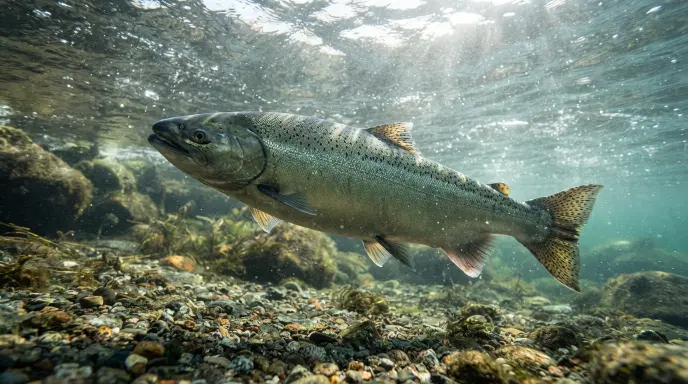
Chinook salmon have several features that can help identify them.
They commonly have a darker back, silvery sides, and a lighter underside. Dark spots can appear across the upper body and tail. The gums may also have dark coloring.
Other noticeable features can include:
- Large body
- Broad shape
- Dark back
- Silver sides
- Light belly
- Dark spots
- Spotted tail
- Dark gums
- Strong jaw in mature males
Their appearance can change as they move from the ocean toward freshwater spawning areas.
Mature fish may become darker and develop stronger shades of red, copper, or other spawning colors.
Because salmon change during their life cycle, appearance should be considered along with location, size, season, and other identifying features.
How Large Can King Salmon Become?
Chinook salmon are famous for their size.
They are generally recognized as the largest Pacific salmon species. Their size can vary widely based on age, environment, food supply, and population.
Some fish are moderate in size, while exceptional Chinook can become extremely large.
This size is one reason anglers value king salmon. Catching a large Chinook can be a memorable experience, especially for people who enjoy salmon fishing.
The name “king” makes more sense when you consider the fish’s size compared with other Pacific salmon.
Is Spring Chinook Another Name for King Salmon?
A spring Chinook is a type of Chinook salmon, so it belongs to the same species as king salmon.
However, the terms are not always identical in meaning.
“King salmon” is a general common name for the species.
“Spring Chinook” adds information about the timing of the fish’s return or run.
In simple terms:
- King salmon identifies the species.
- Chinook salmon identifies the species.
- Spring Chinook gives seasonal information.
- Spring salmon can be a regional name.
- Tyee is a traditional or regional term.
- Blackmouth is a descriptive nickname.
This is why it is better not to treat every salmon term as a direct synonym.
King Salmon Names Used by Fishermen
Fishing communities often develop their own vocabulary.
Depending on where someone fishes, they may use:
- King
- King salmon
- Chinook
- Chinook salmon
- Spring Chinook
- Spring salmon
- Tyee
- Quinnat
- Blackmouth
- Tule
A fisherman might simply say, “We caught a king,” because the local context makes the meaning obvious.
Another person might say “Chinook” instead.
Neither name automatically indicates a different fish.
Regional language is one of the main reasons salmon terminology can seem confusing when you first encounter it.
King Salmon Names Used for Seafood

The term king salmon is very common in seafood conversations.
You may see it on menus, recipes, seafood counters, and product descriptions.
Other terms can include:
- King salmon
- Chinook salmon
- Chinook
- Wild king salmon
- King salmon fillet
- Chinook fillet
- King salmon steak
- Chinook salmon
- King
- Salmon king
If a seafood recipe calls for Chinook salmon, it is referring to the same species commonly called king salmon.
The name can vary, but the fish does not become a different species simply because the label changes.
Best Name to Use for King Salmon
The best name depends on your audience.
1.For a general audience, Chinook salmon is clear and easy to understand.
2.For seafood-related writing, king salmon is a familiar and useful term.
3.For fishing discussions, either name may work, depending on the local vocabulary.
4.For scientific or educational writing, using both names together can remove confusion:
King salmon, also known as Chinook salmon, is a Pacific salmon species.
After that introduction, you can use either term naturally without repeating both names in every sentence.
Quick Guide to King Salmon Names
If you only want the most important information, this short guide can help:
| Term | Meaning |
|---|---|
| Chinook salmon | Main alternative name |
| Chinook | Short form of Chinook salmon |
| King salmon | Common name |
| King | Short form of king salmon |
| Tyee | Regional or traditional term |
| Quinnat | Historical or regional name |
| Spring salmon | Regional or seasonal term |
| Spring Chinook | Seasonal Chinook term |
| Blackmouth | Descriptive nickname |
| Tule | Regional term |
The most important connection is king salmon = Chinook salmon.
The other terms require more attention to context.
How to Choose the Right Term When Writing About King Salmon
Choosing the right salmon name is easier when you know your purpose.
1.If you are writing a basic article, use Chinook salmon or king salmon.
2.If you are writing about seafood, “king salmon” may feel more natural to your readers.
3.If you are discussing seasonal salmon runs, terms such as “spring Chinook” may be more precise.
4.If you are discussing regional fishing traditions, Tyee, Quinnat, blackmouth, or tule may appear naturally.
Avoid treating every regional nickname as a universal synonym. Some terms have a narrower meaning than others.
When in doubt, introduce the fish using both major names:
Chinook salmon, commonly known as king salmon, is one of the best-known Pacific salmon species.
That gives readers the information they need immediately.
FAQs:
What is another name for king salmon?
The most common alternative name for king salmon is Chinook salmon. Both names refer to Oncorhynchus tshawytscha.
Is Chinook salmon the same as king salmon?
Yes. Chinook salmon and king salmon are two common names for the same species.
What are the other names for Chinook salmon?
Other names include king, Tyee, Quinnat, spring salmon, spring Chinook, blackmouth, and tule. Some of these names are regional or descriptive rather than universal.
Why is king salmon called king salmon?
Chinook salmon are called king salmon because they are the largest Pacific salmon species. Their impressive size helped establish the “king” name.
Is Tyee a type of salmon?
Tyee is a traditional or regional name associated with Chinook salmon. It does not refer to a completely separate salmon species.
What does blackmouth mean?
Blackmouth is a nickname associated with Chinook salmon because of the dark pigmentation around the fish’s gums.
Is spring Chinook the same species as king salmon?
Yes. Spring Chinook belongs to the same species as king salmon. The word “spring” provides additional information about the seasonal run.
What is the scientific name of king salmon?
The scientific name of king salmon is Oncorhynchus tshawytscha.
Conclusions:
The easiest answer to another name for king salmon is Chinook salmon. Both names identify the same Pacific salmon species, Oncorhynchus tshawytscha.
You may also encounter Tyee, Quinnat, spring salmon, spring Chinook, blackmouth, and tule. These names can reflect regional traditions, seasonal runs, historical usage, or physical characteristics.
If you need one clear term, Chinook salmon is a strong choice. If you are discussing seafood or fishing, king salmon is equally familiar.
Understanding these names makes salmon-related information much easier to read and helps you avoid confusing Chinook with other Pacific salmon species.

Hi, I’m Evelyn, a writer who enjoys creating simple, useful, and engaging content. I love finding interesting ideas and turning them into easy-to-read articles that people can enjoy and learn from.
My goal is to make every article clear, helpful, and enjoyable for readers. I believe good writing should feel natural, friendly, and easy to understand. Thank you for visiting my site, and I hope you enjoy reading my work!